
Arborist Reports and Documentation

Certified Arborist Reports and Letters
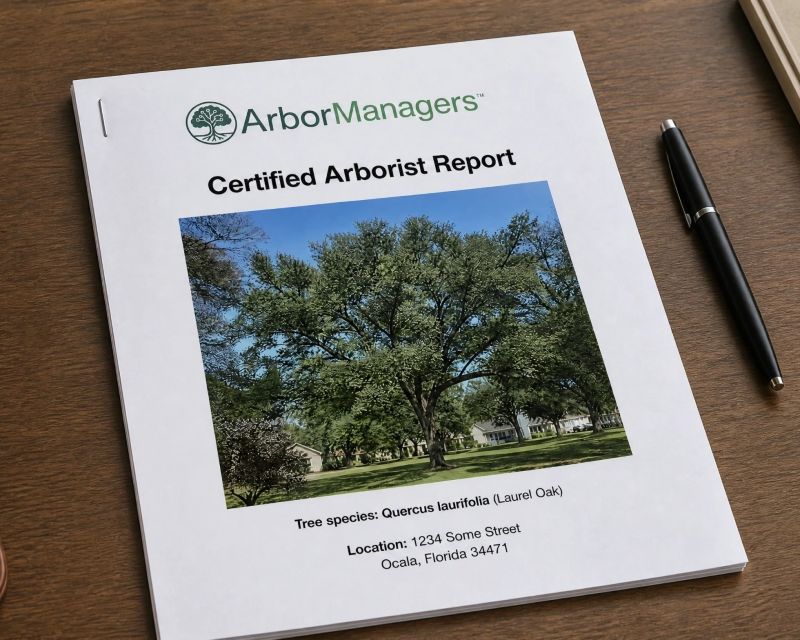
The Purpose of a Certified Arborist Report
Certified arborist reports cover a wide range of arboriculture situations, and the purpose and scope of a field evaluation or service determines which type of report is created. Every arborist report should provide valuable information to help you stay focused on objectives during the decision-making process.
At ArborManagers we understand the importance of each report type, and our reports are developed to ensure they accurately document the findings of evaluations, and provide clear and concise documentation for planning, regulatory compliance, and historical reference.
ArborManagers reports are prepared using aggregated field data collected by an ISA Certified Arborist, and proprietary digital tools, and based on industry standards and best management practices.
Request a ReportTypes of Documentation
Arborist documentation may include:
- Written professional opinions
- Tree-related reports and summaries
- Supporting documentation for permitting or review
- Clarifying statements addressing tree condition, risk, or site factors
- Arborist letters
Professional Opinion and Scope
Professional opinions are based on visible conditions and available information at the time of evaluation. Trees are living organisms, and their condition may change due to weather, site disturbance, or maintenance practices.
Documentation does not guarantee future performance or outcomes. It is intended to provide clarity and professional perspective to support informed decisions.
Assessment vs. Documentation
An assessment is the professional evaluation process, the onsite examination of a tree and its condition. A report is the written documentation created from that process for a defined purpose, such as permitting, municipal review, or legal matters. In many cases both are produced together.
Common Documentation Needs
Permit applications
Many Florida counties and municipalities require a certified arborist letter or report before approving tree removal or significant tree work. We provide the documentation your jurisdiction requires, including hazard determinations that satisfy Florida Statute 163.045 for residential property owners seeking exemption from local permit requirements.
Insurance claims
Post-storm and post-lightning damage assessments with written documentation suitable for insurance submissions. Our reports include photographic evidence, condition findings, and professional opinion on the cause and extent of damage. See our Insurance Claims & Storm Damage page for more detail.
Property transactions
Trees can be a significant factor in the value and liability profile of a property. A certified arborist report provides buyers, sellers, and lenders with an objective professional assessment of tree condition before a transaction closes.
HOA and neighbor disputes
When tree disputes require a professional opinion, an ISA Certified Arborist report provides an objective assessment based on what the tree's condition actually shows, not on the preference of either party.
Development and construction
Development projects often require arborist documentation as part of the permitting process, including tree surveys, preservation plans, and condition ratings for regulated trees on site. We provide the certified documentation Florida counties and municipalities require.
Case Studies
-
Arborist Report Supports Removal of Replanting Requirements
Case StudyThe Challenge
A Tampa property owner was facing separate requirements to install additional trees on a residential lot. The City of Tampa had previously required four Type 1 mitigation trees, while the property's Design Review Board separately required the installation of at least one additional shade tree.
The Assessment
ArborManagers evaluated the existing trees, site conditions, available growing space, and the feasibility of adding the required trees. The findings were documented in a written arborist report prepared by ISA Certified Arborist® Harry Doyle, providing an objective assessment of the existing tree conditions and the practical limitations of additional tree planting on the property.
City of Tampa Decision
After reviewing the arborist report, the City of Tampa removed its previous requirement for the property owner to install mitigation trees. The City's decision was then documented and provided to the Design Review Board as part of the property owner's request for reconsideration.
Design Review Board Decision
The Design Review Board subsequently reviewed the City of Tampa's confirmation that their mitigation requirement had been removed, current photographs showing the size and configuration of the property, a diagram identifying the existing trees, and the written ArborManagers arborist report. After reviewing the documentation and discussing the site conditions, the Board also removed its requirement for an additional shade tree. The decision was formally noted in the property's DRB file.
The Result
One independent arborist assessment contributed to the removal of both the City's mitigation requirement and the Design Review Board's additional shade-tree requirement, and saving the homeowner unnecessary expenses. Instead of adding trees simply to satisfy numerical planting requirements, the existing property conditions were evaluated and documented so that the reviewing authorities could make decisions based on the actual site limitations.
Why Independent Arborist Documentation Matters
Tree regulations and planting requirements do not always account for every site-specific condition. Existing canopy, available growing space, utilities, structures, property dimensions, and the long-term development of proposed trees can all affect whether additional planting is appropriate. An independent arborist assessment provides objective findings and professional documentation that property owners, HOAs, design review boards, and municipal agencies can use when making tree-related decisions.
Deliverables
Arborist reports and letters are provided in a clear written format suitable for submission, review, and recordkeeping. Content and level of detail are aligned with the intended use of the documentation.