
HOA Tree Assessments & Consulting

Central Florida HOA Tree Assessments & Guidance
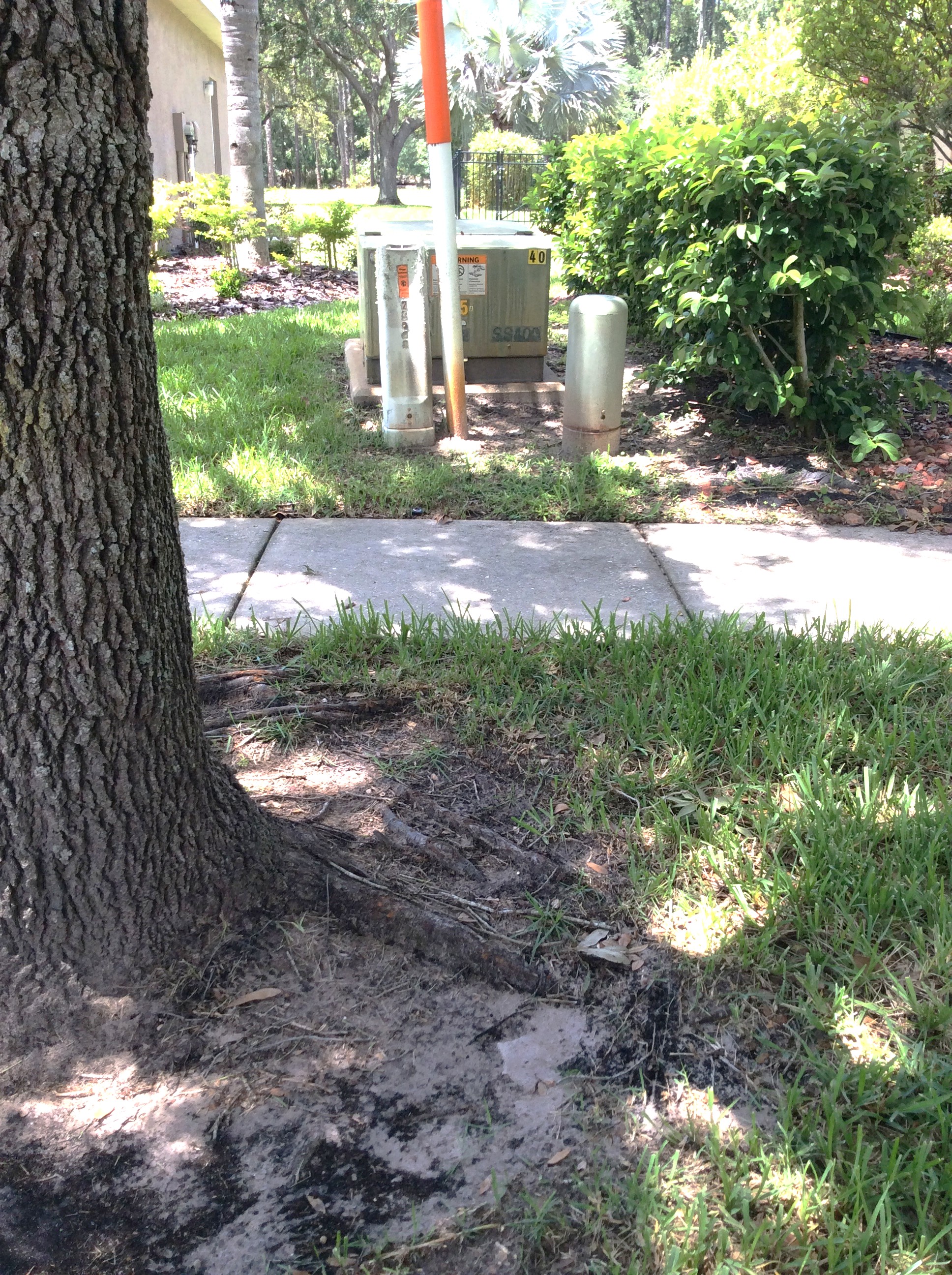
HOA Tree & Infrastructure Conflicts
Tree infrastructure conflicts are common throughout many established Central Florida HOAs. When developers plan and build communities, trees are smaller, and long-term conflicts are less apparent and not recognized, or they do not appropriately plan for future growth constraints. As trees grow their root zones outgrow the limited space available to them and become a problem for surrounding infrastructure like utilities, sidewalks, streets, and driveways.
These conflicts create other issues such as sidewalk trip hazards, storm-water run-off problems, irrigation issues, utility infrastructure damage, large surface-roots which get damaged, affecting the tree's health and structural integrity, and high ongoing maintenance and repair costs.
At ArborManagers, we understand tree infrastructure conflicts, why they occur, their development, and how to manage them. We provide you independent tree assessments, professional documentation, and consulting that helps HOA boards make informed decisions based on safety, tree preservation, budget considerations, and local regulations.
Our tree assessment and consulting services often pay for themselves by helping communities avoid unnecessary work, and focus resources where they are better utilized.
We do not sell or perform tree pruning or removal. Every recommendation we make is based solely on the condition of the trees and their impact on your community and its safety.
Request An HOA AssessmentQuestions about HOA & Community Trees? See answers to common questions about budgeting, storm prep, and infrastructure conflicts on our FAQ page.
Case Studies
-
Central Florida POA Tree Risk and Infrastructure Assessment
Case StudyThe Challenge
A Central Florida POA needed a defensible, professional record of tree conditions across a large stretch of association-maintained right-of-way. Many mature live oaks were showing visible conflicts with sidewalks, curbs, and drainage infrastructure, and the board needed a clear understanding for prioritizing mitigation efforts including removals, retentions, and replacement planting before committing budget to the project.
The association also needed the report structured to support the kind of documentation local tree preservation ordinances typically expect, a defensible separation between tree-risk findings and infrastructure-driven mitigation recommendations, so their decisions could have a solid basis in science and industry best practices.
The Approach
Each of the 28 trees was evaluated individually using a Level 2 Basic Tree Risk Assessment, following ISA Tree Risk Assessment Qualification (TRAQ) methodology and Best Management Practices. Two distinct evaluations were performed for each tree and listed in one report.
- Tree-risk assessment: likelihood of failure, likelihood of impacting a target, and consequence of impact, rated independently of any infrastructure condition.
- Infrastructure-conflict assessment: observable root and hardscape interaction, sidewalk and curb displacement, and utility or drainage constraints, with preservation alternatives evaluated tree by tree.
Every tree received a governing disposition code (retain with mitigation, short-term retention, or removal) tied to a documented basis, along with full photographic documentation.
Key Findings
- Tree Risk Assessment: Out of the 28 trees, 21 rated overall Low tree risk, 7 rated Moderate, 6 with mitigation options, and 1 of with no standards approved mitigation options. None rated High or Extreme.
- Infrastructure-Conflict Assessment: 7 trees were recommended for retention with mitigation and monitoring, 1 of those for short-term retention and monitoring, and 20 were recommended for removal, due to infrastructure conflict assessments.
- Only 1 of the 7 Moderate-risk trees required removal on tree-risk grounds alone, the remainder were infrastructure-driven.
The Outcome
The board received a single, organized report giving them the following.
- A clear, tree-by-tree basis for every removal and retention decision.
- A defensible paper trail distinguishing risk-based removals from infrastructure-based removals, supporting compliance with local tree preservation review.
- A replacement planting plan, including preferred species selections suited to the site's planting strip widths and utility constraints.
- Clear recommended actions for implementation in a timely and effective sequence, based on importance and urgency.
Why This Matters for POA/HOA Boards
Board members are frequently asked to justify tree removal decisions to residents, and sometimes to local permitting authorities. A structured, tree-by-tree assessment gives the board documentation it can point to rather than relying on general impressions or informal recommendations. It also protects the association from claims that healthy trees were removed without cause, since the report shows exactly which trees were retained, which required mitigation, and why, all documented by an ISA Certified Arborist.
Common Tree Conflicts Encountered by HOAs
At ArborManagers, we assess conflicts involving the following HOA/POA infrastructure elements:
- Sidewalk lifting
Sidewalks are commonly affected by tree root growth, leading to lifting and cracking, which can create trip hazards and require continual repairs. While grinding can solve some smaller displacements and buy more time, it doesn't address the underlying root issue.
- Street curbs and gutters
When street curbs and gutters are impacted by tree root growth, lifting and cracking occurs, which also creates trip hazards, problems for car tires parked against the curb, and water retention/puddling on the street.
- Roadways asphalt lifting and cracking
Asphalt repair can be very costly. When tree roots affect roadways leading to lifting and cracking, if not repaired promptly, the damage will escalate over time and become more expensive to address. Even with repair, an arborist needs to be called for proper root management
- Underground utilities encroachment
Underground utilities can be partially susceptible to encroachment by tree roots, leading to damage that may not be immediately visible. When this happens, it can lead to service disruptions and major repair costs.
- Stormwater system conflicts
Stormwater systems can be impacted by tree root growth, leading to blockages and overflow, which can create flooding issues which lead tp other property damage and hazards.
- Retention pond embankment issues
Retention pond embankments can be compromised by tree root growth, leading to erosion and structural damage, which can create environmental safety hazards.
- Gates, signage & lighting
Gates, signage, and lighting are impacted by tree roots and canopy growth, causing obstruction, damage, liability issues, and aesthetic concerns.
Recommendations consider both preservation opportunities and practical infrastructure needs while helping communities avoid unnecessary tree loss whenever feasible.
Central Florida's Urban Forest Preservation
Trees are one of the most valuable assets within our communities. They increase property value, provide shade and protection from the elements, add character to the community, and define the look and feel of its streets and common areas. Trees also represent one of the largest long-term maintenance responsibilities in a community.
Tree preservation is essential for maintaining the health and beauty of our communities. Whether your community consists of a few common-area trees, hundreds, or thousands throughout parks, roadways, retention ponds, and recreational areas, ArborManagers is dedicated to supporting responsible urban forest management through comprehensive tree assessments and strategic tree preservation planning. We help community boards prioritize maintenance, preserve valuable trees when possible, address infrastructure conflicts, and make informed decisions for the community as a whole.
We help associations develop practical urban forest management strategies by identifying priorities such as these.
- Trees requiring immediate attention
- Trees that should be monitored
- Trees suitable for long-term preservation
- Trees approaching the end of their service life
- Opportunities to diversify future tree populations
- Areas where succession planning may be beneficial
HOA Tree Management Plans
An HOA Tree Management Plan is a documented strategy covering tree condition, maintenance priorities, budget planning, and replacement forecasting for a community's common-area trees. Whether a board needs a single-tree assessment or a full community-wide inventory depends on the decision at hand: budget planning, reserve studies, or a large common-area canopy usually call for the full inventory, while a single concerning tree may only need an individual assessment.
Prioritizing Higher-Risk Trees
A tree risk assessment across a community's common-area trees ranks them by risk level, giving the board a clear, documented basis for deciding which trees need immediate attention versus ongoing monitoring, rather than relying on general impressions.
Storm Preparation and Post-Storm Evaluations
A pre-season assessment can flag trees with structural conditions likely to fail in high wind before a storm arrives, while a post-storm evaluation documents damage and helps the board prioritize response. Both give the association a documented, rather than reactive, approach to storm risk.
Our consulting services support these community types.
- Homeowners Associations (HOAs)
- Condominium Associations (COAs)
- Property Owners Associations (POAs)
- Community Development Districts (CDDs)
- Mobile home and manufactured housing communities
Documentation for Tree Planning & Regulatory Compliance
Many associations struggle to determine which trees need attention first or how to plan for future maintenance. Our independent assessments give you unbiased tree condition documentation that helps prioritize work, rather than treating every tree equally. This allows your community to manage their urban forest as a long-term capital asset.
ArborManagers documentation supports your community in the following ways.
- Risk and health-based prioritization for maintenance work
- A documented basis for multi-year maintenance planning
- Forecasting data for future tree replacement needs
- Fewer emergency expenditures through earlier identification of problematic trees
- A clearer basis for maintenance budget decisions
- Condition data to support your board's reserve planning
Many Central Florida municipalities regulate tree removal, preservation, replacement, and construction impacts. The same documentation and consulting can support the following.
- Tree permit applications
- Municipal tree preservation requirements
- Construction planning
- Tree protection planning
- Replacement tree requirements
- Development and redevelopment projects
Requirements vary by municipality, so ArborManagers documentation is tailored to local ordinances and project conditions.
ArborManagers provides comprehensive reports that include the following:
- Tree identification and size
- Tree location information and mapping
- Existing conditions
- Findings
- Risk considerations
- Recommended actions
- Supporting photographs
- Monitoring recommendations where appropriate
Frequently Asked Questions
Do you perform tree trimming or removal?
No. ArborManagers is an independent consulting practice. We assess trees and provide recommendations, but we do not perform tree work.
Can you evaluate an entire community?
Yes. Assessments may range from a single tree to comprehensive evaluations of common areas throughout an HOA or residential development.
Can you help if residents disagree about a tree?
Yes. An independent assessment provides an objective evaluation based on the tree's condition and recognized arboricultural standards, helping boards make informed decisions supported by professional documentation.
Do you present your findings to the HOA board?
Yes. We provide comprehensive digital reports complete with location mapping, photos, and prioritized action items. We can also attend board meetings to walk members through our recommendations and answer any questions.